June 21, 2026 · The MailTrigger Team
Cold Email Reply Rates: 2026 Benchmarks and How to Handle Replies at Scale
Every cold email metric ladders up to one number: the cold email reply rate. Opens are vanity (and increasingly fake), clicks are a proxy, but a reply is a human raising their hand. So what's a good reply rate in 2026, what actually moves it, and — once the replies start coming — how do you handle them at scale without drowning? This guide covers the benchmarks, the levers, and the triage system.
Reply rate is the downstream signal for everything in the cold email deliverability playbook: if placement drops, replies dry up first.
What's a good cold email reply rate in 2026?
Here's where things land, based on aggregated industry benchmarks (figures are approximate and vary by industry, list quality, and offer):
| Reply rate | Where you stand |
|---|---|
| ~1–2% | Below average — usually a targeting or deliverability problem |
| ~3.4% | Average cold email reply rate |
| 5%+ | Good — you're beating most senders |
| Top 15–25% | Excellent — tight targeting + strong personalization |
The average cold email reply rate sits around 3.43%, with anything above 5% considered good and the best campaigns landing in the top 15–25% (approximate — Instantly; The Digital Bloom). If you're under 2%, the fix is almost always tighter targeting and better deliverability, not more volume.
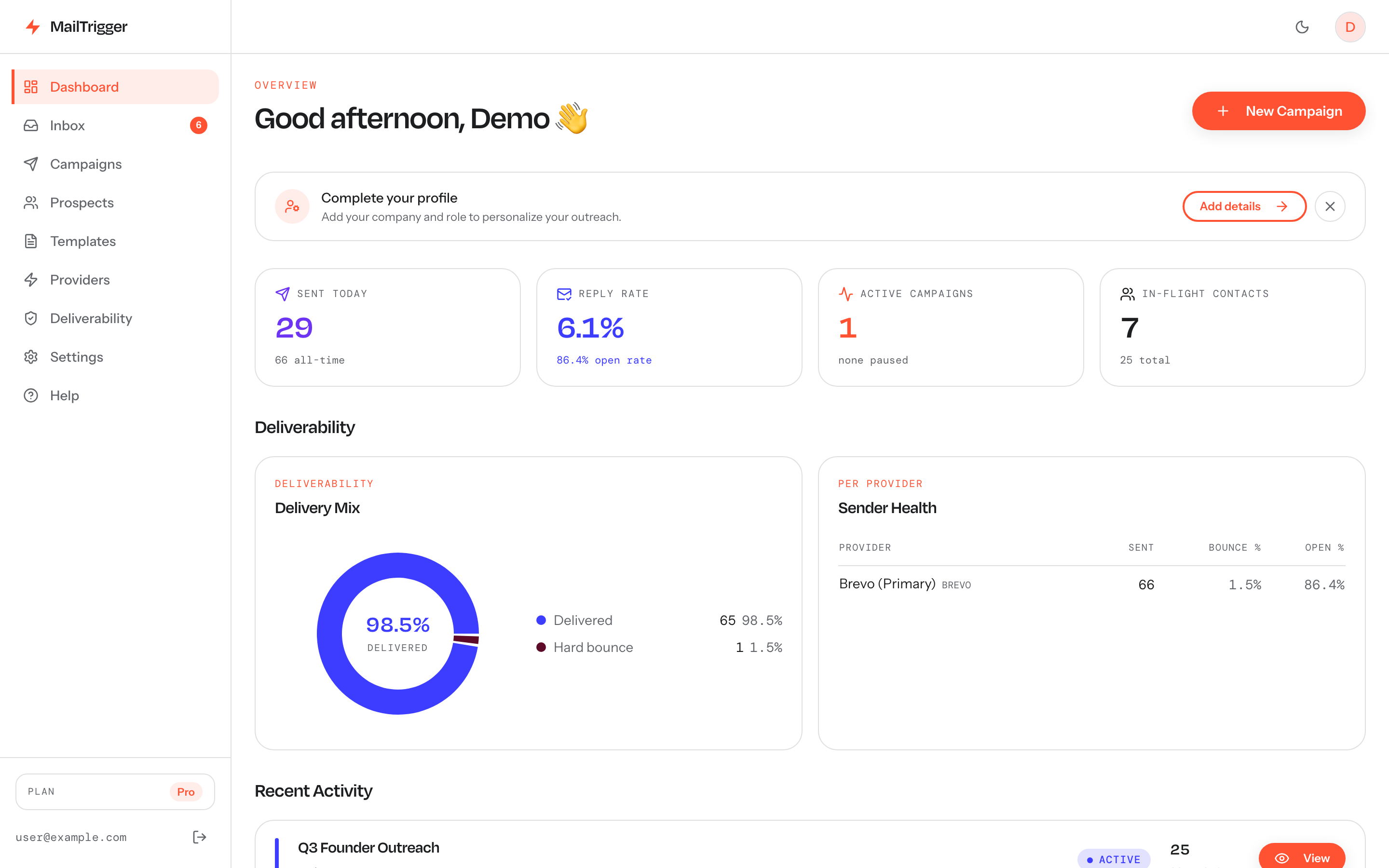 The dashboard surfaces reply rate next to open rate and delivery mix — the at-a-glance view of whether your outreach is actually landing replies.
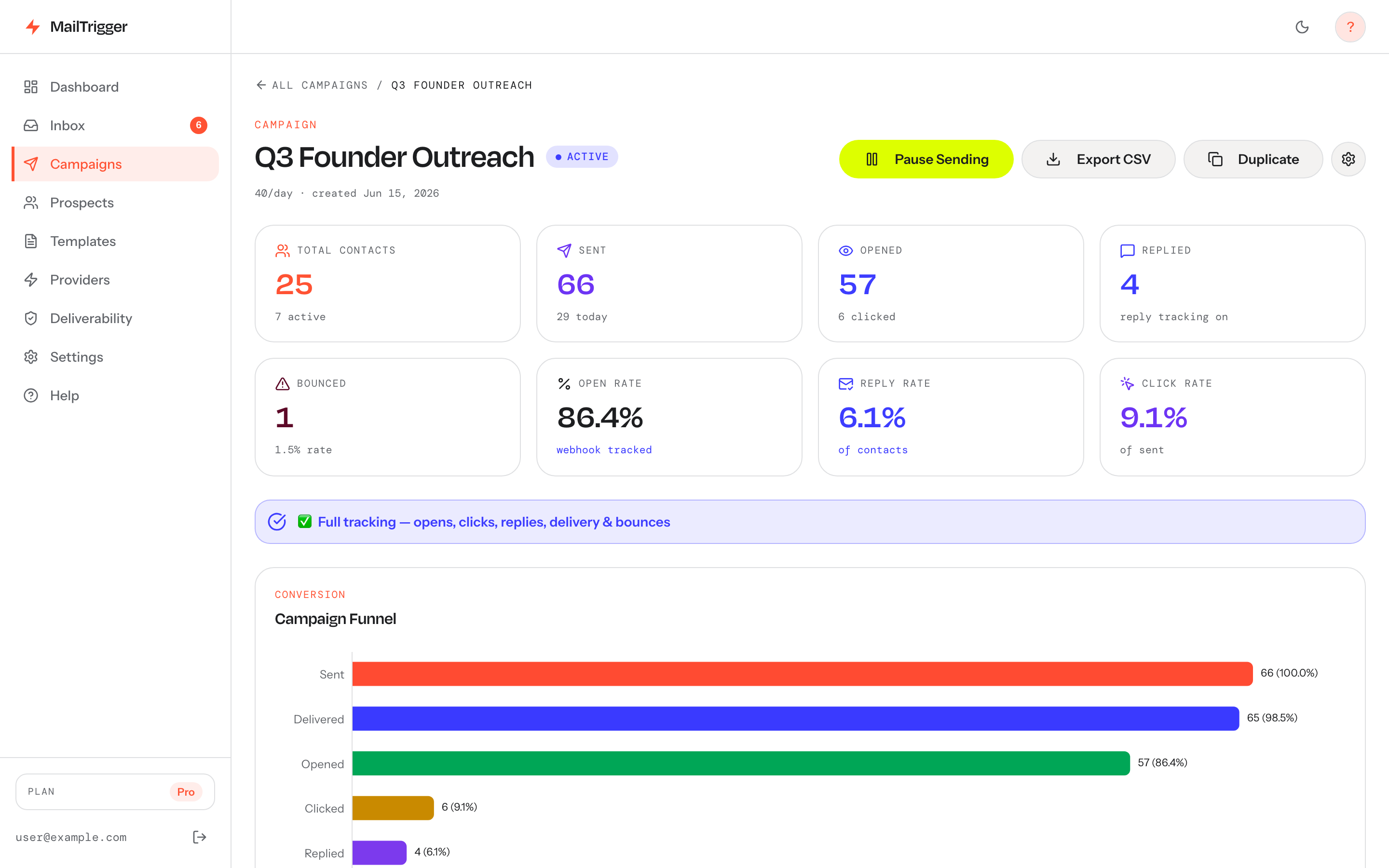 Per-campaign analytics track reply rate alongside opens and clicks and a sent → delivered → opened → clicked → replied funnel, so you can see exactly where prospects drop off against the ~3.4% benchmark.
What drives reply rate
Personalization beats merge tags
Hi {{first_name}} is not personalization — it's a mail merge. Real personalization references something specific: their role, their company's recent move, a shared connection. The payoff is large: personalized campaigns see roughly 52% higher reply rates, and well-targeted outreach can reply at ~2.76× the baseline (The Digital Bloom). One researched sentence beats ten merge tags.
Follow-up cadence
Most replies don't come from the first email. A sequence of 2–4 well-spaced follow-ups consistently lifts total reply rate — without becoming a nuisance. (Mind your daily sending limits so follow-ups don't spike your volume.)
A/B test on replies, not opens
This one trips up a lot of senders. Apple Mail Privacy Protection inflates reported open rates by an estimated 10–20% by pre-loading tracking pixels (Belkins). That makes opens an unreliable optimization target. Test subject lines and copy against reply rate, the metric that reflects real human interest — not against opens you can't trust.
Deliverability and infrastructure
You can't reply to an email you never received. Placement is the precondition for any reply rate, which is why your sending infrastructure choice matters: mail that lands in spam has a 0% reply rate no matter how good the copy.
The problem: drowning in replies
Success creates its own problem. Scale your outreach and you scale your replies — and not all replies are equal. Mixed into the genuinely interested prospects are out-of-office bounces, "not right now," wrong-person forwards, unsubscribe requests, and questions. Sorting them by hand doesn't scale: agencies report manual reply triage consuming 5–10+ hours per day at volume (Instantly). That's time stolen from actually talking to the people who said yes.
Reply triage at scale
Triage is the act of routing each reply to the right next step. The categories that matter:
- Interested — act now, this is the whole point.
- Question — needs a real answer to move forward.
- Not now — nurture and follow up later.
- Out of office — auto-reply; re-queue for when they're back.
- Unsubscribe — honor it immediately (it's also a legal and deliverability requirement).
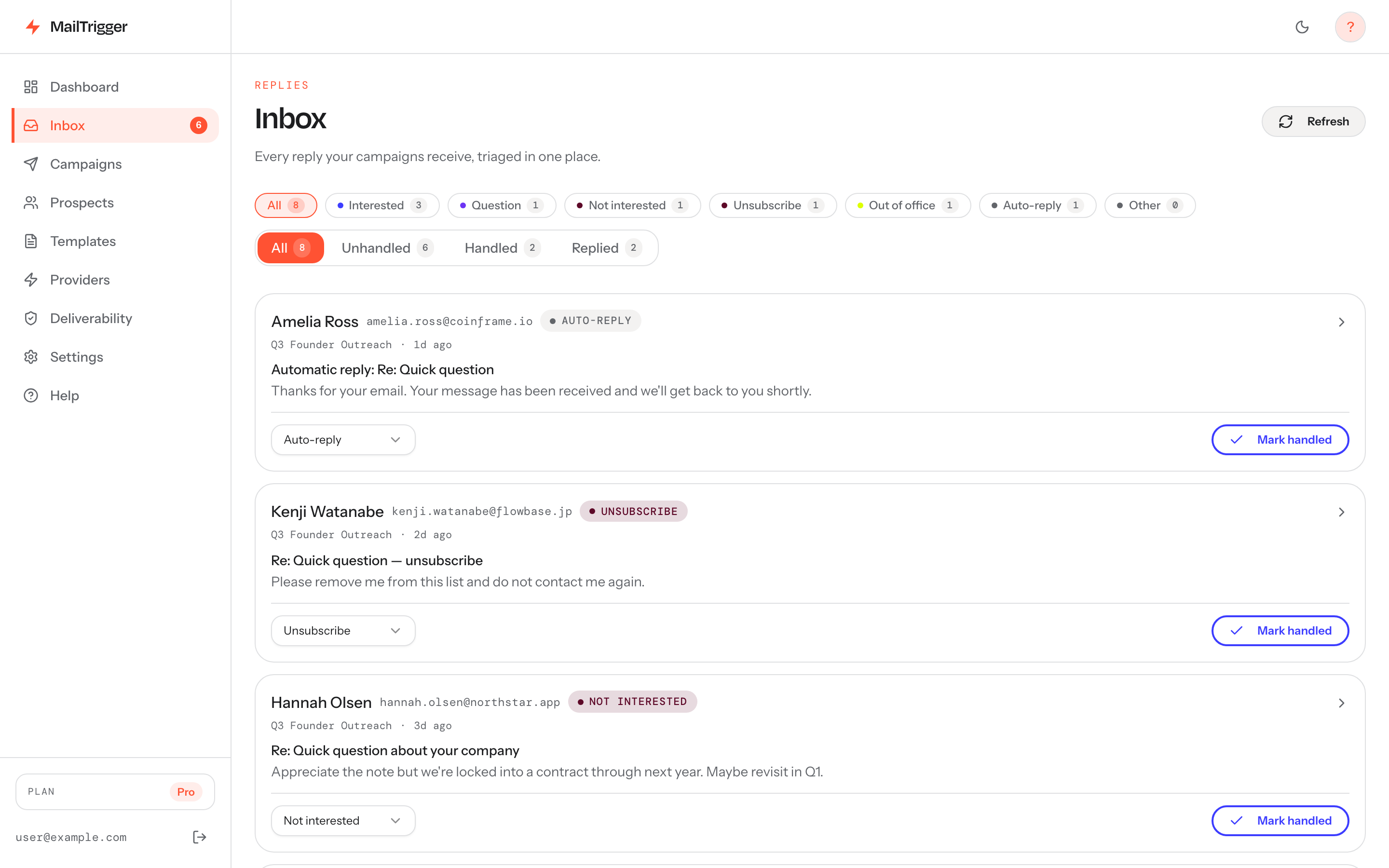
A unified reply inbox auto-sorts every response by intent — Interested, Question, Out of office, Unsubscribe — so the replies that matter rise to the top.
Done manually, this is the 5–10-hour-a-day grind. Done with AI, it's automatic. AI triage automates an estimated 70–80% of reply handling, and modern AI reply classification runs at roughly 85–95% accuracy (Instantly; Instantly). The interested replies surface to the top; the noise gets sorted out of your way.
A unified reply inbox
The cleanest setup pulls every reply into one inbox where they arrive pre-classified — interested, question, not now, out of office, unsubscribe — so you spend your time on the people who matter and see the whole conversation thread in one place. That's exactly what MailTrigger's reply handling does; see the features overview. The result: replies become a prioritized to-do list instead of an overflowing folder.
FAQ
What's a good cold email reply rate?
The average is around 3.4%; 5%+ is good, and the top campaigns hit the 15–25% range (approximate — Instantly). Under ~2% usually points to weak targeting or deliverability problems rather than copy.
How do I increase my cold email reply rate?
Personalize beyond the first name (personalized campaigns see ~52% higher replies — The Digital Bloom), tighten your targeting, add a short follow-up sequence, and make sure you're actually landing in the inbox. Smaller, sharper lists reliably out-reply big blasts.
Should I A/B test subject lines on open rate or reply rate?
Reply rate. Apple Mail Privacy Protection inflates open rates by an estimated 10–20% by auto-loading pixels (Belkins), so opens are an unreliable target. Optimize for the metric that reflects real interest.
Can AI accurately classify cold email replies?
Yes, reliably enough to automate most of the work. AI reply classification runs at roughly 85–95% accuracy and can automate 70–80% of triage (Instantly), surfacing interested replies and filtering out-of-office and unsubscribe noise — turning a 5–10-hour daily chore into a quick review.