June 27, 2026 · The MailTrigger Team
Shared IP vs Dedicated IP for Cold Email — and Why BYOK Beats Both
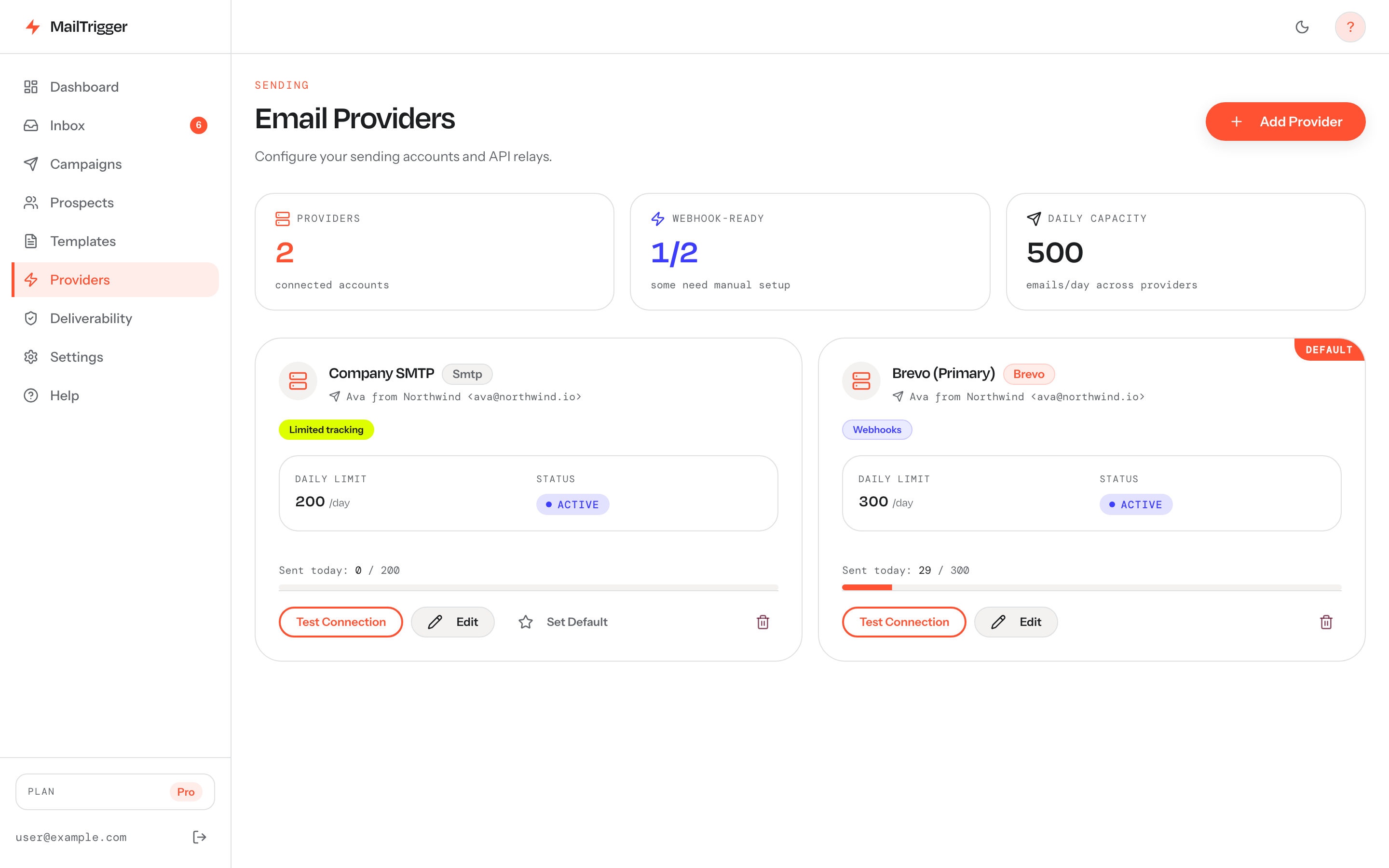
When you pick a cold email tool, you're also picking where your mail physically sends from — and that choice shapes your deliverability more than your copy ever will. The classic debate is shared IP vs dedicated IP for cold email, but there's a third model that quietly outperforms both for most senders: bringing your own provider (BYOK). Let's compare all three honestly, then explain why BYOK wins for the majority of outreach teams.
This is the infrastructure layer of cold email deliverability — get it wrong and even perfect authentication won't save you.
The three models
There are essentially three ways your cold email reaches the world:
- Shared IP pool. Your tool routes your mail (and everyone else's) through a shared set of IP addresses. Zero setup, lowest cost.
- Dedicated IP. You get an IP all to yourself. Full control, full responsibility, higher cost.
- BYOK (bring your own key). You connect your own email provider account — Brevo, SendGrid, Resend, SES, or SMTP — and your mail sends through it under your own reputation, on the ESP's official infrastructure.
The hidden risk of shared IP pools
Shared pools are attractive because they're cheap and require no warm-up of your own. But the trade-off is brutal: you inherit the reputation of every other sender on the pool. If one of them blasts spam, gets flagged, or runs a sketchy list, the whole pool's reputation drops — and your perfectly clean campaign lands in spam through no fault of your own.
Worse, you have no recourse. You can't see who else is on the pool, you can't kick them off, and you can't move your reputation with you. One bad neighbor can tank your deliverability overnight, and there's nothing you can do but wait or switch tools (Instantly). For cold email — already a sensitive sending category — that's a serious gamble.
Dedicated IPs: better, but not for everyone
A dedicated IP fixes the bad-neighbor problem: your reputation is yours alone. But it comes with real strings attached:
- You must keep it warm. A dedicated IP needs consistent, sustained volume to build and hold reputation. Send too little and providers never establish trust.
- It's table stakes only at scale. Industry guidance puts the threshold for a dedicated IP making sense at roughly 150,000+ emails per month (Smartlead). Below that, you can't generate enough volume to keep the IP warm, and a poorly-warmed dedicated IP performs worse than a shared one.
- It costs more and adds operational overhead.
For high-volume senders, dedicated IPs are the right call. For everyone else — the vast majority of cold outreach teams — they're overkill that can backfire.
The third way: BYOK (bring your own provider)
Here's the model that fits most senders: connect your own email provider and send through it. Your mail goes out on the official infrastructure of an established ESP (or your own Google/Microsoft inbox), under your own domain and your own reputation — not a pool you share with strangers.
BYOK works with the inbox you already have — Gmail, SendGrid, SES, Postmark, Brevo, Mailgun, MailerSend, Resend or plain SMTP — so you send on an established ESP's infrastructure, never a shared pool.
Why it works so well:
- Your reputation, your control. Nobody else's spam can drag you down. The reputation you build is yours and moves with you.
- Better placement than pools. Sending on official ESP infrastructure delivers roughly 15–50% better inbox placement than shared SMTP pools (approximate, vendor-reported — Smartlead).
- No warm-up cliff. You're not trying to single-handedly warm a dedicated IP; you ride on the ESP's mature sending infrastructure while building your domain reputation through normal warm-up and sending limits.
- It's the industry direction. Leading outreach tools have shifted toward routing mail through user-owned Google Workspace and Microsoft 365 inboxes rather than shared pools, precisely because placement is better (Salesforge).
Full disclosure: MailTrigger is a BYOK tool — that's the whole premise. You connect Brevo, SendGrid, Resend, Amazon SES, Mailgun, Postmark, MailerSend, or plain SMTP, and we never touch a shared pool. Pricing is flat and billed by contacts, not per-email, so scaling volume doesn't inflate your bill. See the connect-your-provider features and pricing.
To send under your own reputation, you still need SPF, DKIM and DMARC configured on your domain — BYOK makes that authentication actually pay off, because the reputation it builds is entirely yours.
Which model should you choose?
| Your situation | Best model |
|---|---|
| Just starting / low volume (< ~50k/mo) | BYOK — own reputation, no pool risk, no warm-up cliff |
| Mid-volume outreach team | BYOK — best placement-to-effort ratio |
| High volume (150k+/mo), dedicated infra team | Dedicated IP — worth the cost and warm-up at this scale |
| Want cheapest, accept the risk | Shared pool — but know one bad neighbor can sink you |
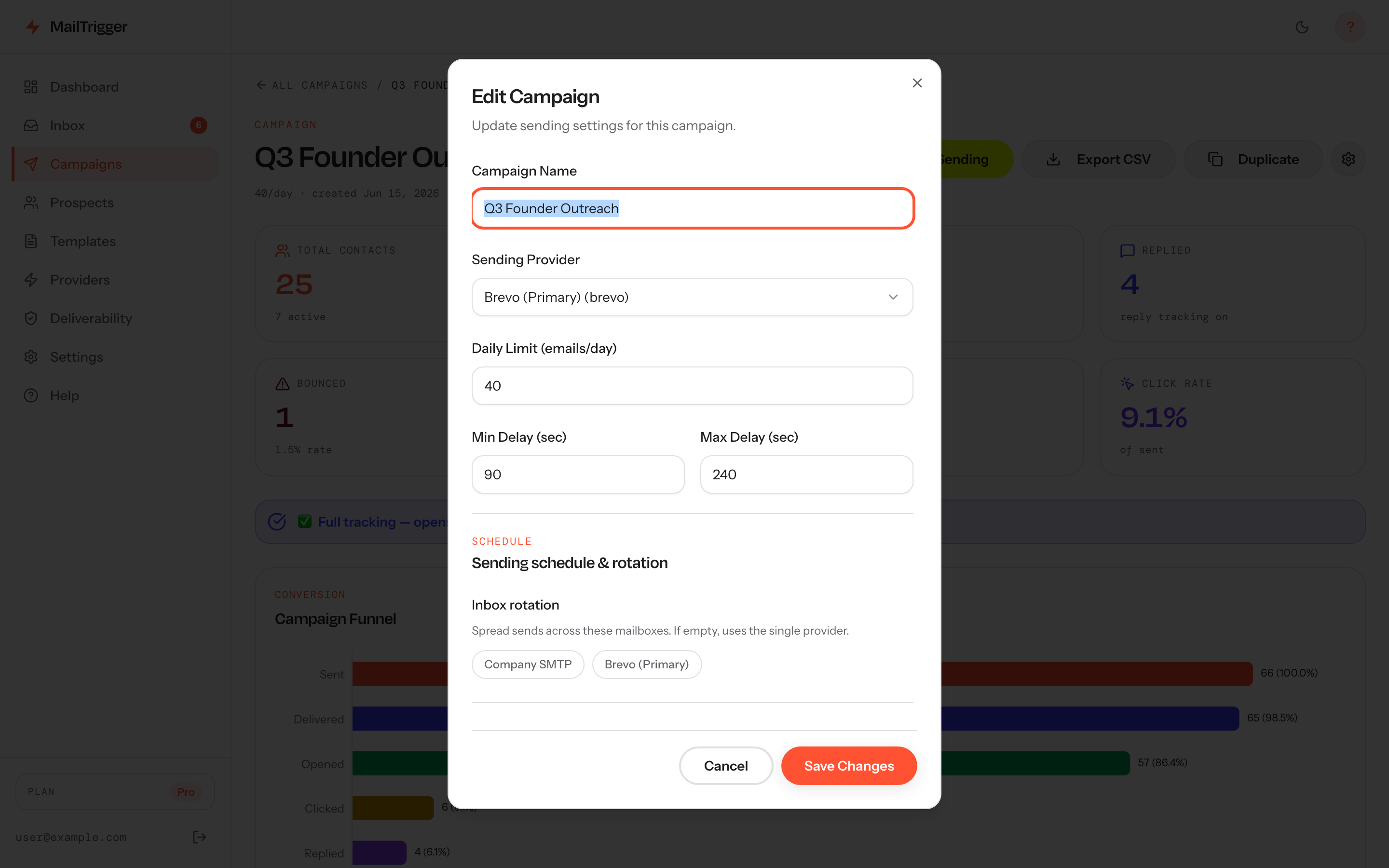 Whichever model you land on, the sending tooling matters: rotating sends across your own connected inboxes, with a daily cap and randomized delays, protects the reputation you've chosen to build.
For most cold email senders, BYOK is the sweet spot: the reputation control of a dedicated IP without the volume requirement or cost, and none of the shared-pool downside.
FAQ
Are shared IP pools bad for cold email?
They carry real risk. Because you share reputation with every other sender on the pool, one spammer can tank your deliverability with no recourse for you (Instantly). They're cheap and zero-setup, but for a sensitive category like cold email, that shared exposure is a meaningful gamble.
Can I use my own SMTP or email provider for cold email?
Yes — that's the BYOK model. Tools like MailTrigger let you connect your own Brevo, SendGrid, Resend, SES, Mailgun, Postmark, MailerSend, or SMTP account, so your mail sends under your own reputation on the ESP's official infrastructure. It's increasingly the industry standard (Salesforge).
Do I need a dedicated IP for cold email?
Only at high volume. A dedicated IP needs consistent sending to stay warm and generally makes sense above ~150,000 emails per month (Smartlead). Below that, you can't keep it warm enough, and BYOK gives you reputation control without the requirement.
Does BYOK actually improve deliverability?
It helps, because your placement isn't dragged down by anonymous pool-mates, and you send on mature ESP infrastructure — estimated 15–50% better placement than shared pools (approximate, vendor-reported — Smartlead). It's not magic: you still need proper authentication, warm-up, and clean lists. But it removes a major variable you otherwise can't control.