June 27, 2026 · The MailTrigger Team
Cold Email for Agencies: How to Land Clients in 2026
Cold Email for Agencies: A Repeatable System to Land Clients
For most agencies, cold email is the cheapest, most controllable client-acquisition channel there is. Referrals are great until they dry up. Paid ads burn cash and attract price shoppers. Cold email, run as a system, lets you decide exactly which companies you want as clients and start a conversation with them this week — for the cost of a tool and your team's time. The catch is that "run as a system" part: agencies that treat cold email as a repeatable machine win; agencies that send sporadic blasts don't.
This guide lays out that machine: picking a niche and a sharp offer, building a targeted list, the agency sequence that books calls, sending at volume without burning your domain, and managing campaigns across multiple clients.
Why cold email is the cheapest client-acquisition channel for agencies
Agencies sell high-value, relationship-driven services — exactly the kind of deal where a direct, relevant email outperforms a banner ad. One landed client can be worth thousands a month, so even a modest reply rate pays for itself many times over. And unlike referrals, cold email is a tap you can turn up: want more pipeline next month? Send to more of the right people.
Set expectations honestly, though. B2B cold email reply rates run about 1–5% in 2025, so this is a volume-and-consistency game. The agencies that win don't have a magic email — they have a tight niche, a sharp offer, and a sequence they run every single week.
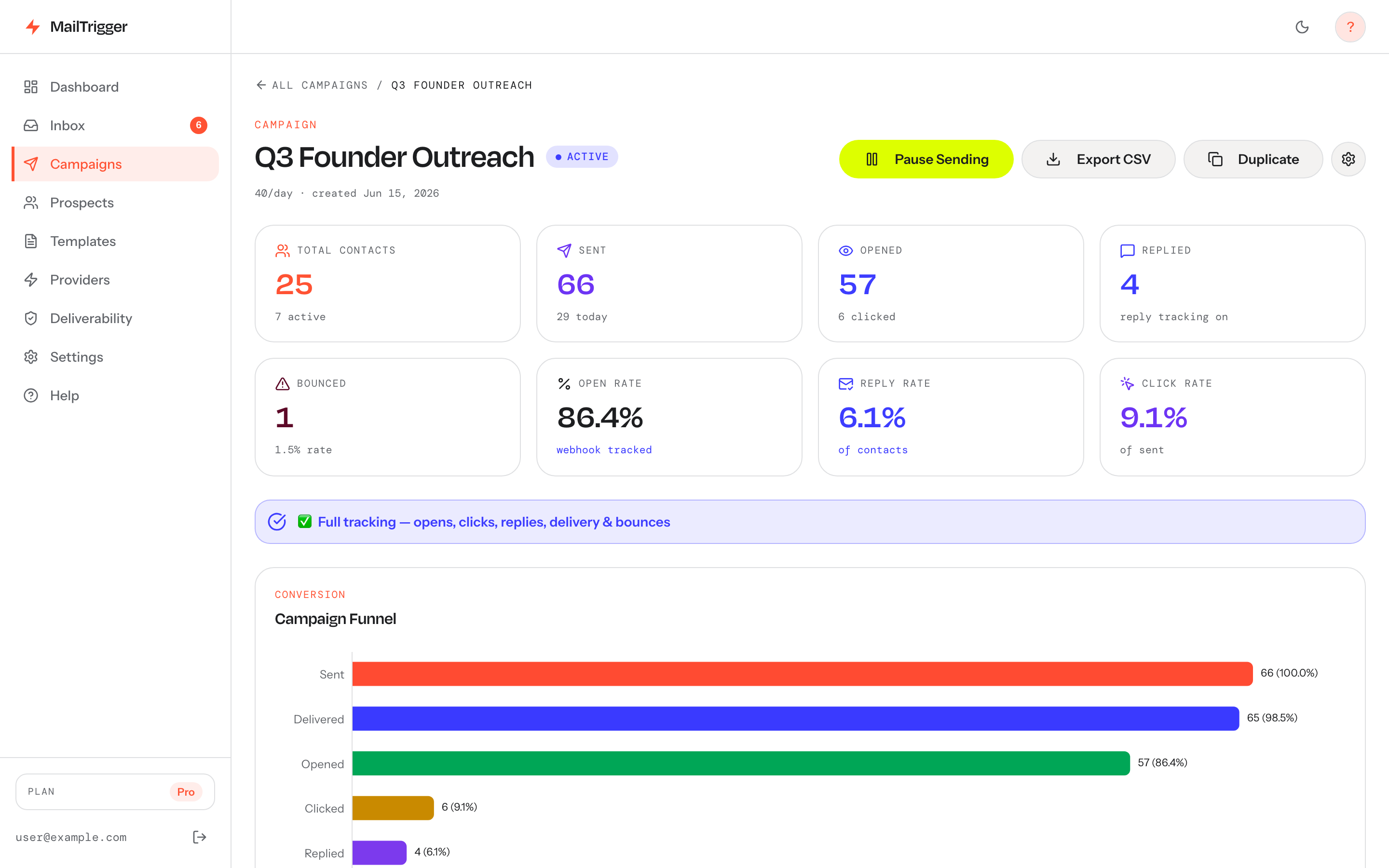
An agency's cold email system lives or dies on measurement — per-campaign reply, open, and click data tells you which niche and offer to double down on.
Pick a niche and a sharp offer (generalists lose)
The fastest way to fail at agency cold email is to pitch "marketing services" to "businesses." A prospect can't tell if you understand their world, so they ignore you. Niche down hard:
- Vertical: "We help Shopify skincare brands" beats "we help e-commerce."
- Outcome: Lead with a specific, believable result, not a service list. "We get DTC brands a 3x return on cold email" is an offer; "we do email marketing" is a description.
- Proof: A relevant case study in your niche is your single strongest asset. It turns "who are you?" into "oh, you've done this for someone like me."
A sharp niche also makes personalization trivial — when every prospect is in the same world, your first line writes itself.
Building a targeted list
Your list quality caps your results. Garbage in, blacklist out. Build it deliberately:
- Define the exact firmographic + role. E.g., "Founders and Heads of Growth at DTC skincare brands doing $1–10M, on Shopify."
- Pull from a real data source. Apollo, LinkedIn Sales Navigator, or a vertical directory. If you use Apollo, export and clean it properly — our guide on using Apollo contacts for cold email covers exporting, deduping, and avoiding Apollo's deliverability pitfalls.
- Verify every address. Bounces above a few percent signal abuse to mailbox providers and put your domain at risk.
- Segment by angle. Group the list so each segment gets a first line and case study that fit them.
The agency sequence
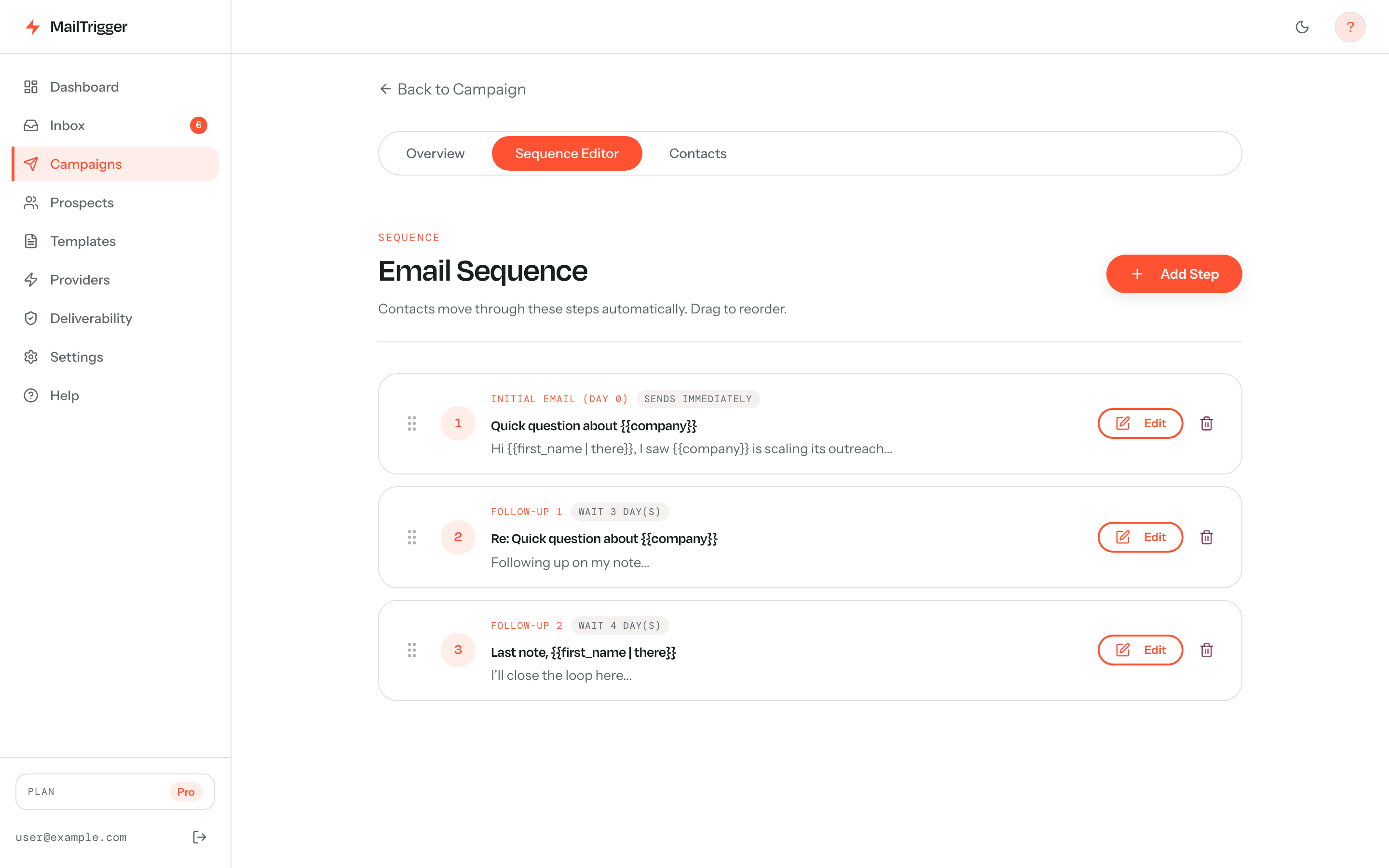
One email won't land a client. A 3–4 step sequence, each touch adding a new angle, does the heavy lifting. Lead with proof, keep the CTA soft:
Email 1 — Case-study angle (Day 0) Subject: {{their_niche}} brands + cold email Hi {{first_name}}, we recently helped {{similar_brand}} {{specific_result}}. Noticed {{company}} is {{relevant_observation}} — worth a quick look at whether the same play fits you?
Email 2 — Soft proof + value (Day 3) A one-line teardown of something on their site/funnel + how you'd improve it. No hard ask.
Email 3 — Direct CTA (Day 7) "Worth a 15-minute call to see if we can do for {{company}} what we did for {{similar_brand}}?"
Email 4 — Breakup (Day 12) "I'll stop reaching out — but if growing {{outcome}} is a 2026 priority, I'd love to help."
Specific, timeline-based hooks consistently outperform generic problem statements — benchmark data shows timeline-based openers reply at roughly 9.9–10.7% versus 3.9–4.8% for generic problem-led ones. The breakup email reliably pulls a surprising number of replies by creating a gentle deadline.
Sending at volume without burning your domain
Agencies need more volume than a solo founder, which makes deliverability discipline non-negotiable:
- Use separate sending domains. Never send cold mail from your primary agency domain. Use dedicated lookalike domains so a reputation hit never touches your real email.
- Authenticate everything. SPF, DKIM, and DMARC on every sending domain — required by Gmail and Yahoo for bulk senders. See our SPF, DKIM and DMARC guide.
- Spread volume across inboxes and the day. Don't push one inbox to its ceiling or blast in a single burst. Pace sends and cap per-inbox daily volume — the safe numbers are in how many cold emails you can safely send per day.
- Warm up new domains/inboxes before scaling. Reputation is earned slowly and lost instantly.
The full playbook is in our cold email deliverability pillar.
 Sending at agency volume safely means spreading mail across the day with randomized delays and per-campaign daily caps — bursts are what get domains flagged.
Managing multiple campaigns and clients
Run cold email for several clients (or several offers) and the operational load multiplies: different domains, different lists, different sequences, different reply queues. You need a tool that keeps these cleanly separated and lets sends scale without per-email pricing eating your margin.
This is MailTrigger's lane. You bring your own key — connect your own (or each client's own) email provider: Brevo, SendGrid, Resend, SES, Mailgun, Postmark, MailerSend, or SMTP — so every campaign sends under the right sender's reputation, on infrastructure you control. Pricing is flat and billed by contacts, not per email or per inbox: $9/month for up to 5,000 contacts, $49/month for up to 50,000, with unlimited sends — so scaling outreach doesn't scale your bill. You get sequences with randomized-delay humanization, daily caps, timezone send windows, open and click tracking, and IMAP reply detection.
Be straight about the trade-offs for agencies specifically: MailTrigger has no whitelabel/client-portal, no inbox rotation, and no native warmup network. If your model depends on managing dozens of rotating inboxes per client under your own brand, a platform like Smartlead is built for that — we compare them fairly in MailTrigger vs Smartlead, and if you're specifically evaluating switching, see our Smartlead alternative breakdown. MailTrigger fits agencies that value reputation control, simple flat pricing, and clean per-client BYOK setups over rotation and whitelabel.
Size it on the pricing page.
FAQ
How many emails does it take to land one client?
Work the math honestly. At a ~3% reply rate with maybe a third of replies being positive, expect roughly one interested conversation per ~100 tightly-targeted contacts — and you'll close a fraction of those. To land a client or two a month, plan on a steady flow of hundreds of well-targeted, warmed-up sends per week per offer. Tighter niche and stronger proof shift those odds in your favor.
Should I use a separate sending domain for client outreach?
Yes — always. Use dedicated lookalike domains for cold outreach, separate from your agency's primary domain and from each other where it makes sense. This protects your real email reputation and contains any deliverability problem to a domain you can replace.
Cold email vs LinkedIn for agencies — which is better?
They complement each other. Cold email scales and is fully under your control; LinkedIn adds a warm, visual touch and works well as a second channel. Many agencies open on email and reinforce with a LinkedIn connection. MailTrigger is email-only, so if multichannel is core to your model you'll want a dedicated multichannel tool alongside it.
What's a good reply rate for agency cold email?
1–5% is the normal B2B band; 7%+ marks a strong campaign. For agencies, a sharply niched list with a relevant case study can sit at the higher end. Track positive reply rate and booked calls — not just opens — to judge whether a niche and offer are working.