June 28, 2026 · The MailTrigger Team
MailTrigger vs Apollo: Data Platform vs Cold Email (2026)
MailTrigger vs Apollo: Where Each Wins (and Why You Might Use Both)
The honest framing for MailTrigger vs Apollo is that they're not really the same category. Apollo.io is a B2B data platform — a massive contact database with sequencing bolted on. MailTrigger is a dedicated sending tool — a flat-priced BYOK cold email tool with no database, built to send and track outreach under your own reputation. The most common smart play isn't picking one; it's using Apollo for data and a dedicated sender for delivery.
Disclosure up front: MailTrigger is our own product, so treat its column as a vendor's pitch and verify. Apollo is excellent at what it's best at, and we'll say so plainly before drawing any contrast.
At a glance: different categories
| Dimension | Apollo.io | MailTrigger |
|---|---|---|
| Category | B2B data platform (+ sequencing) | Dedicated cold email sender (BYOK) |
| Pricing | Per-user + credits | Flat, billed by contacts |
| Entry (as of 2026, verify current) | Basic ~$49/user/mo | Free 250; $9 Basic (5k); $49 Pro (50k) |
| B2B database | 150M–275M+ contacts | None — bring your own |
| Credits | Expire monthly, no rollover | N/A (no data product) |
| Native warmup | No (discontinued 2024) | No — bring your own |
| Sending deliverability | Reported 15–35% bounce | BYOK — your ESP, your reputation |
| Sequences | Yes | Yes (humanized delays, caps) |
| Open/click tracking | Yes | Yes |
| Reply detection | Yes | Yes (IMAP polling) |
| Best for | Prospecting & data | Sending & deliverability |
The verdict in one line: use Apollo to find and export your prospects; use a dedicated sender like MailTrigger to actually email them.
Pricing: per-user + credits vs flat-by-contacts
Apollo prices per seat with credit-metered data. As of 2026, Basic runs around $49/user/month (annual), Professional around $79, and Organization around $119 with a 3-seat minimum (apollo.io/pricing — verify current pricing). The catch most teams hit is credits: data credits are consumed as you reveal contacts and expire monthly with no rollover (apollo.io/product/b2b-data, verify current).
MailTrigger bills on contacts — Free (250), $9/mo (5,000), $49/mo (50,000) — with unlimited emails, no per-seat charge, and no credits to expire. But it sells no data at all, so the numbers aren't directly comparable: you're paying Apollo for data, and MailTrigger for sending.
The big difference: data vs delivery
Apollo's strength is its database. Depending on the source, it's cited at roughly 150M contacts refreshed monthly (official) up to 270M+ in third-party reviews (apollo.io/product/b2b-data, verify current). For prospecting — building targeted lists by title, industry, technology, and intent signals — that's enormous value, and MailTrigger has nothing like it.
MailTrigger has no lead database. You bring your own data. Where it shines is the other half: turning a list into clean, well-paced, tracked outreach that lands in the inbox under your own sender reputation.
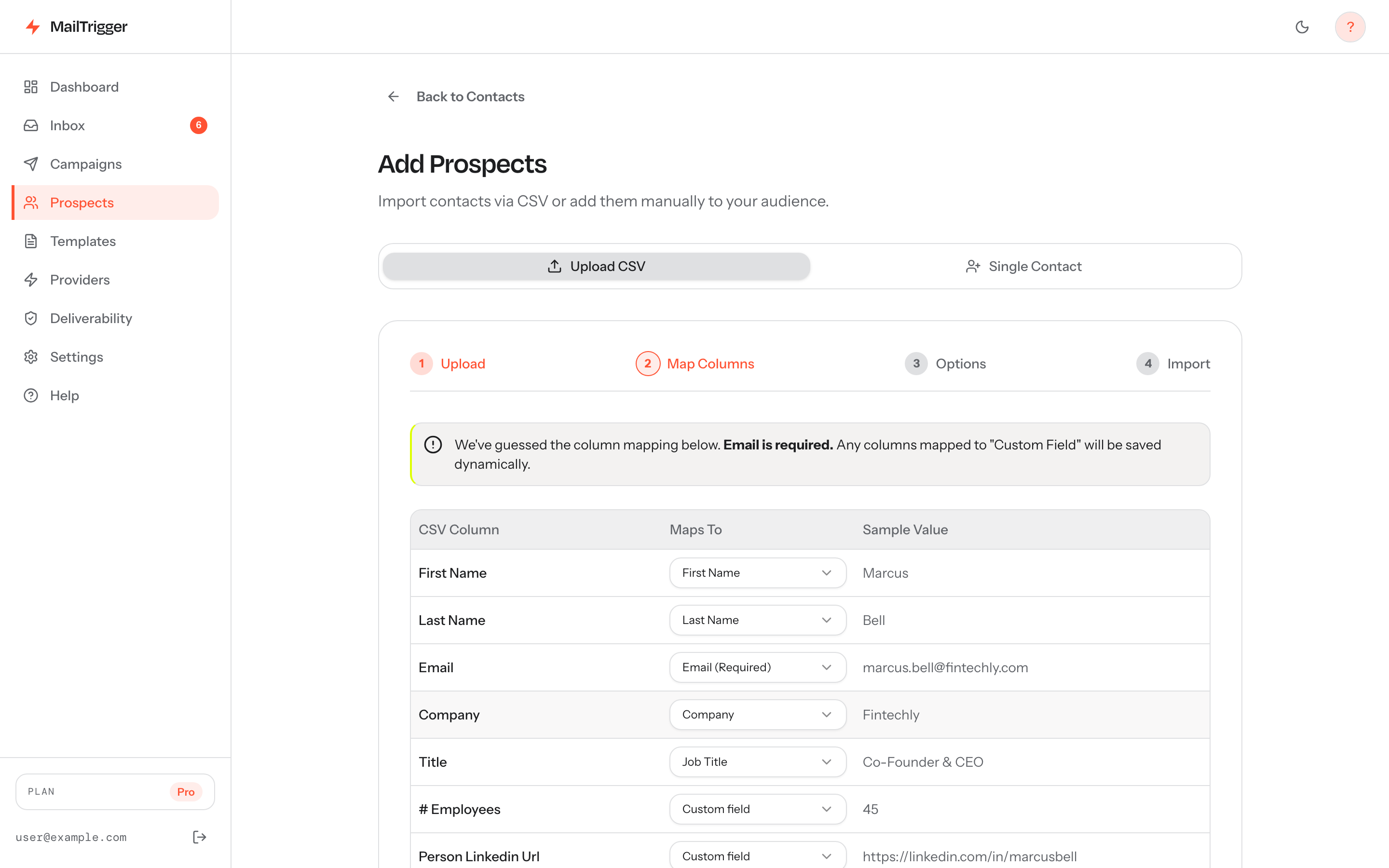
MailTrigger has no database of its own — but its CSV import is Apollo-aware, so a list exported from Apollo maps cleanly into a campaign.
Sending & deliverability
This is where the "data platform doing email" tension shows up. Apollo discontinued its built-in email warmup in 2024, and real-world reports put cold-send bounce rates from Apollo sending in the 15–35% range (mailreach.co). Apollo also defaults to a conservative cap of around 50 emails/day per mailbox (knowledge.apollo.io). None of that makes Apollo bad — it makes it a data tool whose sending is a secondary feature.
A dedicated sender is built for placement. MailTrigger is BYOK — your mail goes out on the official infrastructure of an ESP you trust (Brevo, SendGrid, SES, Mailgun, Postmark, MailerSend, Resend, or SMTP), under your own reputation, with randomized delays, daily caps, and send windows. To be fair, MailTrigger has no native warmup network either — bring your own warmed inbox — but its whole job is sending, so the controls are deeper.
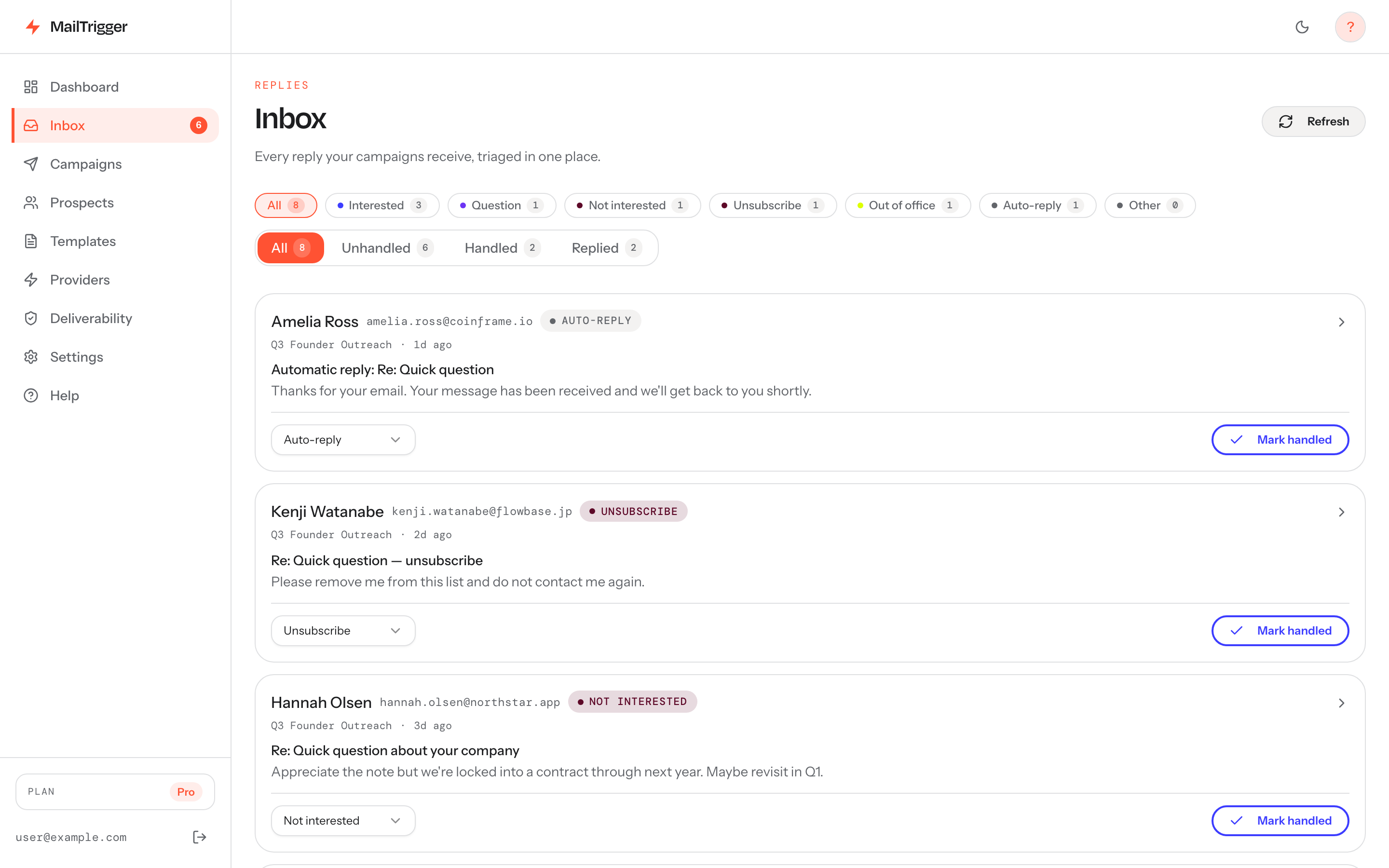 A dedicated sender focuses on the send-and-reply loop — paced delivery, open/click tracking, and IMAP reply detection — rather than treating email as a feature of a data tool.
Why dedicated senders tend to place better comes down to reputation and infrastructure — see shared IP vs dedicated IP for cold email and how many cold emails you can safely send per day.
The "use both" play
For most teams this is the answer. Prospect in Apollo, export the list, and send through a dedicated tool. You get Apollo's data depth and a sender built for deliverability, instead of leaning on Apollo's de-emphasized sending. MailTrigger's Apollo-aware CSV import is built precisely for this handoff — see our guide on how to use Apollo contacts for cold email for the step-by-step.
Who picks which
- Pick Apollo if your bottleneck is finding prospects — you need a large, filterable B2B database with intent signals, and you're fine sending lighter volume from within it. As a data platform, it's hard to beat.
- Pick MailTrigger if your bottleneck is sending — you already have data (often from Apollo) and want clean, paced, tracked delivery under your own reputation at a flat price. It has no database and no warmup, so it complements a data tool rather than replacing one.
- Use both if you want Apollo's data and better placement than Apollo's own sending tends to give.
For the wider sending picture, see the cold email deliverability playbook, or start free on the MailTrigger landing page.
FAQ
Is Apollo good for sending cold email?
Apollo is excellent for finding prospects but weaker at sending them. It discontinued built-in warmup in 2024, real-world bounce rates are reported around 15–35%, and it defaults to roughly 50 emails/day per mailbox (mailreach.co). For deliverability-sensitive cold email, many teams export Apollo data and send through a dedicated tool.
Does Apollo have email warmup?
No — Apollo discontinued its built-in warmup feature in 2024 (mailreach.co). MailTrigger doesn't have a native warmup network either, so in both cases you'd bring your own warmup (a dedicated warmup service or an already-established inbox).
Can I export Apollo contacts to MailTrigger?
Yes. Export your list from Apollo as a CSV and import it into MailTrigger — the import is Apollo-aware and handles the column mapping automatically. That's the recommended "use both" workflow; see how to use Apollo contacts for cold email for details.
What are Apollo's free plan limits?
Apollo offers a free tier, but it's credit-limited and the paid tiers start around $49/user/month (annual) as of 2026, with credits that expire monthly and no rollover (apollo.io/pricing — verify current pricing). MailTrigger's free plan covers 250 contacts with unlimited emails, but it includes no data — it's a sender, not a database.